Stargazing
A stargazing forecast for tonight
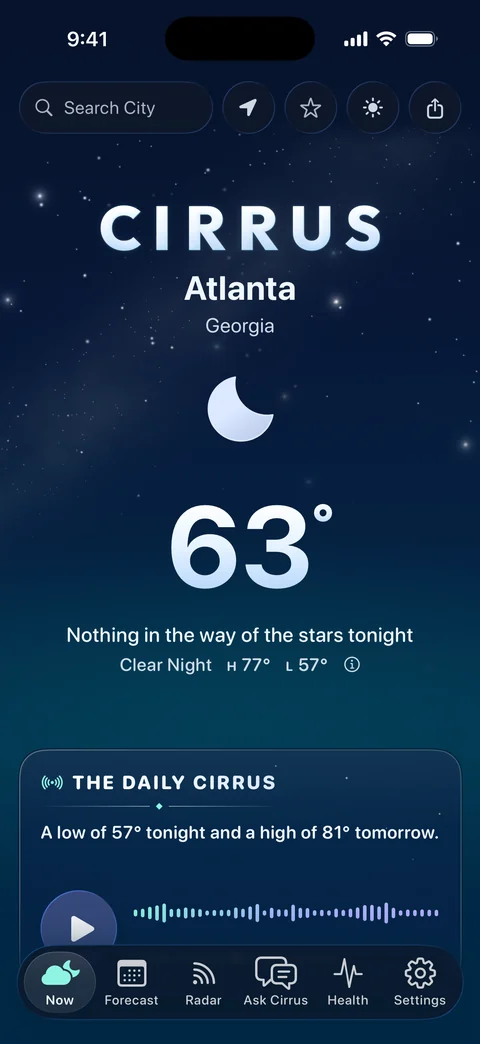
Cirrus rates tonight’s sky from 1 to 5 stars from the cloud forecast and the moon, and names the best window to look up. The same card shows the next time you can see the ISS and when a meteor shower peaks, and the Sky and Space page adds the northern lights. These are part of a Cirrus subscription.
Is tonight good for stargazing?
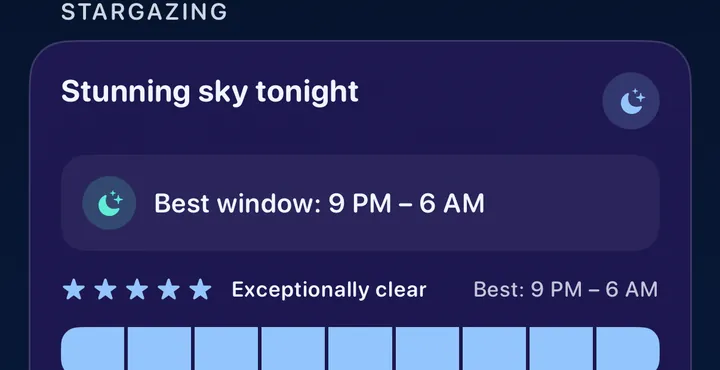
A good night needs a clear sky, full darkness, and not too much moon. Stargazing checks the cloud forecast for each hour after the sun is well below the horizon, finds the longest clear stretch, and grades it, like “Stunning sky tonight,” with the best window, such as 9 PM to 6 AM. A bright moon lowers the grade, because it washes out faint stars.
- The best window to look up, and when the sky is fully dark
- How much of the moon is lit
- Planets up after dark, and where to look, like “Look NE · 23° up”
Can I see the ISS tonight?
You can see the International Space Station when it passes over while your sky is dark and the station is still in sunlight, usually in the hours after dusk or before dawn. Cirrus works out the next pass you can see from where you are and shows the time, where it rises, how high it climbs, and how long it lasts, like “Streaks overhead at 9:14 PM.” If there is no pass tonight, it shows the next one.
Meteor showers
Cirrus follows nine major showers, from the Quadrantids in January to the Ursids in December. Around a peak, the card says when it peaks, about how many meteors an hour to expect, which way to face, and whether the moon will get in the way.
Without a subscription, Cirrus can still send a note on the evening a major shower peaks. You’ll find it under Meteor Showers in Settings.
The northern lights and the moon
The Aurora card reads NOAA’s space weather data, shows how strong it is right now on a scale of 0 to 9, and says how strong it needs to be for you to see the lights from where you are. When a strong storm is underway, the card moves up to your main screen. The Sky and Space page also has the moon’s phase and NASA’s image of the day.
Part of a Cirrus subscription
Stargazing, ISS passes, the Aurora card, and the Sky and Space page are part of a Cirrus subscription, $9.99 a month or $39.99 a year, on iPhone and iPad.
Questions people ask
Can I see the ISS tonight from my location?
It depends on whether the station passes over you while your sky is dark and the station is still lit by the sun. Cirrus checks this for where you are and shows the next pass you can see: the time, where it rises, and how high it gets. It is part of a Cirrus subscription.
Is there an app that tells you about meteor showers tonight?
Yes. Cirrus shows when a major meteor shower peaks, about how many meteors to expect an hour, and how bright the moon will be. Without a subscription, it can still send a note on the evening a shower peaks.
Does Cirrus have an aurora forecast?
Yes, with a subscription. It reads NOAA’s space weather data and tells you whether a display is likely from where you are. It does not send aurora alerts.
Does Cirrus show a star map through the camera?
No. Cirrus tells you whether tonight is clear, when to look, and which way. It does not name the stars through your camera.